

How to Manage Travel Agency Leads and Follow-Ups Effectively
Running a travel agency involves much more than finding hotels, arranging transport and preparing holiday packages. Every day, travel agents also need to answer enquiries, understand customer requirements, prepare quotations and follow up with people who are still deciding where to travel.
Some customers are ready to book within a few hours. Others may compare several packages, discuss their budget with family members or wait until their leave is approved. The challenge is to keep track of every enquiry without spending the entire day checking WhatsApp messages, emails and spreadsheets.
This is where a proper travel agency lead management process becomes useful. With a clear system, travel agents can organise enquiries, remember important follow-ups and understand which opportunities need attention first.
In this guide, we will look at practical ways to manage travel enquiries, follow up with potential customers and build a more organised booking process.
What Is Travel Agency Lead Management?
Travel agency lead management is the process of recording, organising and following up with people who enquire about travel services.
A lead could be someone asking for a family holiday package, a couple planning a honeymoon, a business looking for corporate travel arrangements or a customer interested in an international tour.
Managing these enquiries properly means keeping important details in one place, such as:
- Customer name and contact details
- Preferred destination
- Expected travel dates
- Number of travellers
- Approximate budget
- Package or service discussed
- Quotation status
- Next follow-up date
- Current booking status
These details help an agent understand the customer’s requirements without asking the same questions repeatedly.
For example, if a customer enquires about a five-day Kerala holiday for a family of four, the agent should be able to find that information when contacting the customer again. A clear record makes the conversation easier and helps the agent provide more relevant options.
Why Travel Agencies Lose Track of Enquiries
Many small travel agencies begin with simple tools. Customer details are saved in a notebook, quotations are shared through WhatsApp, and follow-up dates are remembered mentally.
This approach may work when enquiry volumes are low. Problems can arise as the business receives more enquiries or several employees start handling customers.
1. Enquiries arrive through different channels
A customer might contact the agency through a website form, phone call, social media message, referral or WhatsApp. When these enquiries remain scattered across different places, it becomes harder to maintain a complete record.
A central lead register gives the team a consistent place to record each new enquiry.
2. Follow-ups depend on memory
A customer may ask for a quotation today and request a callback after discussing it with their family. If the agent forgets to record the date, that opportunity can easily be overlooked.
Recording the next action and its due date makes follow-ups part of the daily workflow rather than a task that depends on memory.
3. Quotations are sent but not reviewed
Sending a quotation does not always mean the customer has made a decision. They may have questions about hotel options, transport, inclusions or the total cost.
Without a follow-up process, the agent may never learn what is stopping the customer from proceeding.
4. Team members have incomplete information
If one employee receives an enquiry and another handles the quotation, both need access to the relevant customer details. Otherwise, customers may have to explain their requirements again.
A shared process helps the team understand who is handling each enquiry and what has already been discussed.
How to Manage Travel Agency Leads Step by Step
You do not need a complicated process to improve lead management. Start with a few consistent steps and make sure the team follows them every working day.
Step 1: Record every new enquiry
Whenever a potential customer contacts your agency, create a record instead of leaving the details only in a chat or personal notebook.
Start with the customer’s name, contact information, destination, travel dates, group size and budget, where available.
Do not delay recording an enquiry because some details are missing. You can update the record after speaking with the customer.
Step 2: Understand the customer’s requirements
Before suggesting a package, ask a few useful questions.
- Where would the customer like to travel?
- What are the preferred travel dates?
- How many adults and children will be travelling?
- What is the approximate budget?
- Are there any specific hotel, transport or activity preferences?
- When does the customer expect to make a decision?
These answers help the agent prepare a suitable quotation instead of sending generic packages that may not match the customer’s needs.
Step 3: Assign responsibility for the enquiry
Every active enquiry should have a clear owner. In a small agency, that may be the owner or one travel consultant. In a larger team, enquiries can be distributed among different agents.
The important point is accountability. Someone should know which customers need a quotation, which customers are waiting for answers and which customers need a follow-up.
If responsibilities are unclear, two employees may contact the same customer while another enquiry receives no response.
Step 4: Keep quotation details organised
Once the customer’s requirements are clear, prepare the quotation and record when it was shared.
It is useful to note the package discussed, the approximate cost, the main inclusions and any questions the customer raised. If the quotation changes, record the updated details so that the team knows which version was discussed most recently.
Travel costs and availability can change. Before confirming a booking, verify the latest supplier rates, hotel availability and other relevant arrangements.
Step 5: Set a specific follow-up date
Avoid notes such as “call later” or “follow up soon”. Record a practical next action and a date.
For example:
| Enquiry status | Next action |
|---|---|
| New enquiry | Contact the customer and understand requirements |
| Requirements discussed | Prepare and share a quotation |
| Quotation sent | Ask whether the customer has questions |
| Customer comparing options | Clarify preferences and discuss suitable alternatives |
| Booking decision pending | Agree on a suitable follow-up date |
| Booking confirmed | Record confirmation and remaining actions |
| Not proceeding | Record the reason, if the customer shares it |
The exact stages can vary by agency. What matters is that every active enquiry has a clear status and next step.
Step 6: Follow up helpfully, not repeatedly
A good follow-up should help the customer make a decision. Simply sending “Any update?” several times does not add much value.
Instead, refer to the customer’s requirements and ask a useful question.
For example:
“Hello Rahul, I wanted to check whether you had a chance to review the Kerala package we discussed. If you would like to adjust the hotel category or travel dates, I can check suitable alternatives.”
This approach keeps the conversation relevant and gives the customer an easy way to respond.
Respect the customer’s preferred communication method and requests not to be contacted. Avoid excessive messages or calls.
Step 7: Update the final outcome
When a customer confirms a booking, update the enquiry status and record the relevant confirmation details. If the customer decides not to proceed, record that outcome as well.
Where appropriate, note the reason, such as a change in travel dates, budget constraints or a decision to postpone the trip.
Over time, these records can help the agency identify common objections and improve its sales process.
Is Excel Enough for Travel Agency Lead Management?
Excel or Google Sheets can be a practical starting point for a small agency. A well-maintained spreadsheet can store customer details, quotation status, follow-up dates and booking outcomes.
However, spreadsheets require regular updates. As the number of enquiries grows, it can become difficult to maintain consistent records, coordinate several employees and identify overdue follow-ups.
A spreadsheet may still suit your business if one person manages most enquiries and the volume is manageable. A dedicated CRM becomes worth evaluating when the team needs a more structured way to handle customer records and daily follow-up work.
Consider the differences before deciding.
| Requirement | Spreadsheet | Travel CRM |
|---|---|---|
| Store customer details | Yes | Yes, depending on the product |
| Track enquiry status | Can be maintained manually | Often available through structured lead records |
| Record next follow-up date | Manual entry | Depends on available reminder features |
| Coordinate team responsibilities | Requires careful sharing and updating | May support assignment and shared records |
| Review sales activity | Requires manual reports | Reporting depends on the CRM’s features |
| Manage travel-specific workflows | Requires a customised sheet | Depends on the product and its capabilities |
A CRM is not automatically the right choice for every agency. Choose it when the time saved, visibility gained and workflow improvements justify the cost and setup effort.
What Should You Look for in Travel CRM Software?
If you are considering a CRM for your travel agency, evaluate it against the work your team actually performs.
Lead and customer management
The system should make it practical to find customer records, review requirements and understand the current status of each enquiry.
Follow-up tracking
Check whether you can record the next follow-up date, review pending actions and identify enquiries that need attention.
If reminders are important to your team, confirm how they work during a live demonstration rather than assuming that every CRM includes automatic reminders.
Quotation and booking workflow
Review how the software supports your quotation process and whether it helps your team maintain the information needed as an enquiry progresses towards a booking.
Do not assume that every CRM includes live hotel inventory, flight booking, supplier integrations or automatic itinerary generation. Verify these requirements separately.
Team access and responsibility
If several employees handle enquiries, check how records are shared and whether responsibilities can be assigned clearly.
Also ask about user access, data backup, account security and how customer information can be exported if you change systems.
Reports and visibility
Useful reports may help you understand the number of enquiries received, the status of quotations and the outcomes of follow-ups. Check which reports the software actually provides and whether they match your business needs.
Ease of use
The best system is one your team will use consistently. Ask the people who handle enquiries to test the software before making a decision.
How Dialbee Travel CRM Can Fit Into Your Workflow
Dialbee offers a dedicated Travel CRM solution for businesses that want a more organised approach to travel enquiries and customer management.
Instead of choosing software based only on a feature list, travel agencies should review how the available workflow fits their daily operations.
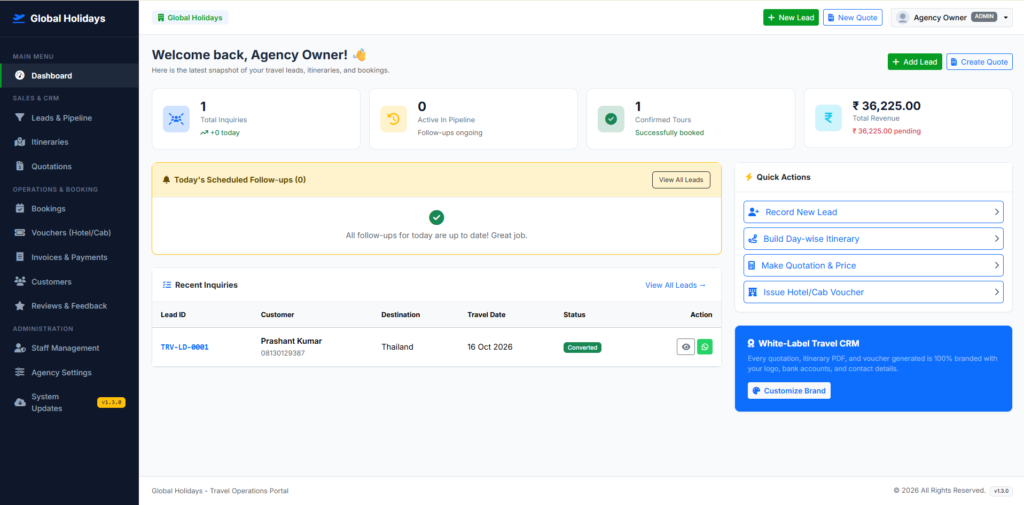
You can explore the Dialbee Travel CRM page to learn more about the solution and then open the live demo to review the interface.
Before deciding, check the specific features you need, the way customer records are handled and whether the system fits your team’s enquiry and booking process.
A useful evaluation starts with your actual workflow. Try a sample enquiry, record customer requirements, review the next steps and check whether the process is easy for your team to follow.
A Simple Daily Routine for Travel Agents
Lead management works best when it becomes part of the team’s regular routine.
At the start of the day: Review new enquiries, quotations awaiting a response and follow-ups due that day.
During working hours: Record new enquiries, update customer requirements and note the next action after important conversations.
Before closing for the day: Check which follow-ups are still pending and make sure active enquiries have an appropriate next step.
At the end of the week: Review confirmed bookings, lost enquiries and common reasons customers did not proceed.
This routine does not need to take hours. Even a short, consistent review can make it easier to spot unfinished tasks before they are forgotten.
Final Thoughts
Managing travel agency leads is not just about collecting customer phone numbers. It is about knowing what each customer needs, what has already been discussed and what should happen next.
Start with a consistent process for recording enquiries, preparing quotations and scheduling follow-ups. Review the process regularly and improve it as your agency grows.
If spreadsheets and manual tracking are becoming difficult to manage, explore whether a dedicated Travel CRM can make your daily workflow easier.
Want to see how a dedicated travel CRM works? Visit the Dialbee Travel CRM page or explore the live demo.
Frequently Asked Questions
What is the best way to manage travel agency leads?
Start by recording every enquiry in one place, capturing the customer’s travel requirements, assigning responsibility and recording the next follow-up date. Review pending enquiries regularly and update each record when the customer responds.
Can a small travel agency manage leads using Excel?
Yes. Excel or Google Sheets can work for a small agency with a manageable number of enquiries. A CRM may be more suitable when multiple employees need to coordinate records, follow-ups and reporting.
How often should a travel agent follow up with a customer?
There is no single schedule that suits every enquiry. Agree on a reasonable follow-up time based on the customer’s decision timeline, quotation status and communication preferences. Avoid excessive calls or messages.
What information should a travel agency record for every lead?
Useful details include customer contact information, destination, travel dates, group size, budget, preferences, quotation status, next follow-up date and final outcome. Collect only the information needed for the service.
How can travel CRM software help travel agents?
Depending on the product, travel CRM software can help organise customer records, track enquiry status, manage follow-ups and review sales activity. Agencies should verify specific features during a demo before purchasing.
When should a travel agency switch from spreadsheets to a CRM?
Consider switching when updating records takes too much time, follow-ups are frequently missed, several employees need to share information or management cannot easily review the status of enquiries.